


Overview
The effective and safe management of tailings continues to be one of PTFI’s priorities. PTFI operates a controlled riverine tailings management system, which was implemented based on methods approved and permitted by the Indonesia government.
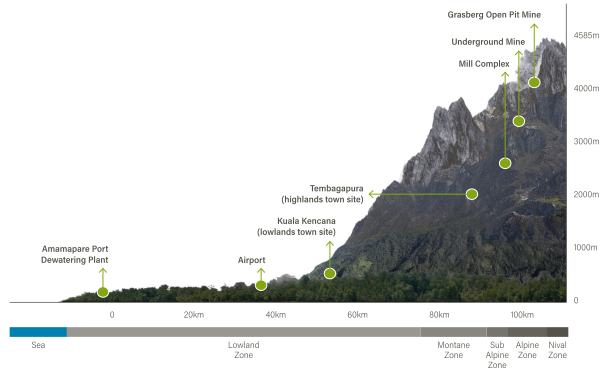
PTFI’s controlled riverine tailings management system uses the Aghawagon/ Otomona River to transport tailings from the concentrator in the highlands along with natural sediments to a large engineered and managed deposition area in the lowlands. This river was chosen because that part of the river is unnavigable and not used for potable water, agriculture, fishing or other domestic or commercial uses.
Situated in the lowlands, the Modified Ajkwa Deposition Area (ModADA) is the containment and retention system for tailings produced at the concentrator, as well as other sediments transported down the river. The ModADA is the terrestrial portion of the tailings management deposition area covering an area of approximately 230 square kilometers (km2). Quantities of finer tailings and other sediments deposit in the estuary portion of the permitted tailings management area and subsequently the sea to the south. PTFI continues to employ tailings management techniques that are aimed at enhancing the deposition of tailings on land within the ModADA.
PTFI has constructed and maintains approximately 120 kilometers (km) of levees and mangrove protection structures. These structures contain sediments in the ModADA and constrain deposition in the estuary area to the approved boundary. Sedimentation within the ModADA is regularly evaluated using advanced modeling software, which reproduces historical sedimentation accumulation and provides forecasts of future sedimentation based on mining plans. PTFI continues to assess and evaluate additional ways to manage and further reduce the potential impacts of its controlled riverine tailings management system on the environment and our local communities, with a view toward continuous improvement.
Tailings Governance
PTFI implements comprehensive and robust governance and oversight processes for its tailings management system. In addition to regular internal and external audits and assessments, oversight of the controlled riverine tailings management system is conducted by:
- FCX Corporate Senior Leadership — Participates in key decisions and provides resources to site management.
- FCX Corporate Tailings and Water Team — Technical resources that provide support and assist with guidance and direction for our site tailings team and associated program initiatives.
- Site Tailings Management, Engineers and Operators — Internal team that implements the program and regularly monitors, identifies and addresses potential risks associated with the ModADA and coastal zone.
- External Design Engineer — External resource that provides design and engineering support, periodic inspections and levee construction quality review.
- ModADA Management Board — Multi-disciplinary expert panel that convenes yearly to provide oversight and recommendations to PTFI leadership and engineering teams on priority activities including safety, risks associated with the ModADA and coastal zone, the structural integrity of the levees, geochemical stability of the deposited sediments, environmental considerations and stakeholder engagement.
EFFECTIVELY MANAGING TAILINGS GEOCHEMISTRY
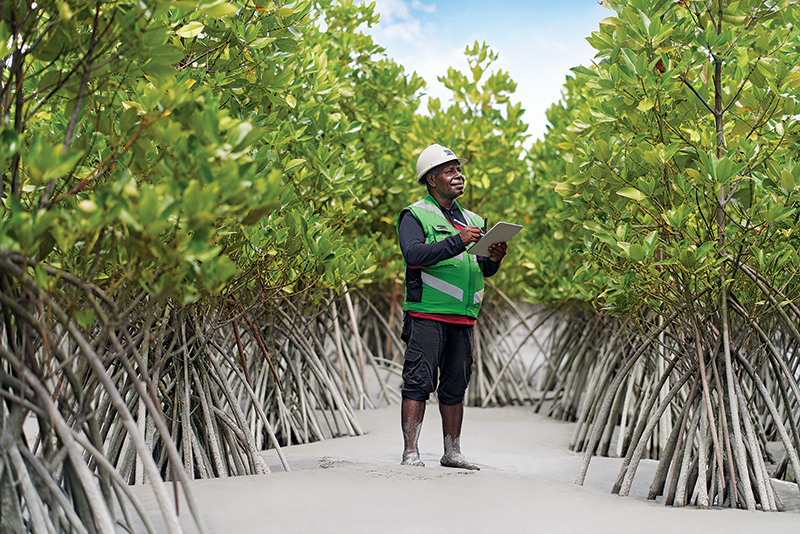 Tailings from Grasberg are specifically managed to avoid generation of acid-forming tailings, so they can safely be deposited into the controlled tailings system. PTFI manages the geochemistry of the tailings based on its understanding of the characteristics of the geology and mineralogy of the Grasberg minerals district ore body and through effective mine plan sequencing. Further, PTFI analyzes geochemistry through the extensive monitoring and sampling programs at both the mill and within the controlled tailings system.
The mine plans for PTFI’s Grasberg minerals district have been developed, and are continually re-evaluated, with a goal of achieving its targeted geochemical balance. PTFI's mine plans are developed to either avoid higherpyrite zones (zones with more acid producing potential) or allow for blending of higherpyrite zones with higher carbonate zones (zones with acid neutralizing potential) when the ore is delivered to the mill.
Before the tailings enter the controlled riverine tailings management system, the tailings are sampled several times daily at the mill to determine whether the desired geochemical balance has been achieved to avoid generation of acid-forming tailings. PTFI analyzes the tailings samples to understand their acid production and neutralization potential in addition to their metal content and particle size. The information from this sampling program informs the mill operators about the expected behavior of the tailings with respect to potential acid generation, and if any adjustments to mill feed should be made, such as the addition of limestone. This process forms the basis of the mill’s ability to confirm and maintain production of non-acid forming tailings.
In addition to monitoring and managing the tailings at the mill, PTFI also regularly tests the deposited sediments within the ModADA. If the geochemical balance is not at the desired level, PTFI may blend the material with higher neutralizing material until it reaches the desired level.
Best Site-Specific Tailings Management System
PTFI’s mines and concentrator complex are located in the highlands of the Grasberg minerals district at elevations exceeding 2,700 meters above sea level. This setting presents unique topographical, hydrological and geotechnical challenges that limit the feasibility of conventional tailings storage facilities, including extremely high annual rainfall (up to approximately 500 inches per year), active seismic conditions associated with the tectonically active “Ring of Fire,” limited availability of cleared and level land, and the large volume of tailings generated since mining inception (approximately 1.85 billion metric tons through 2025).
Tailings management alternatives have been evaluated since the early phases of PTFI’s operations, including during production expansion planning in the 1990s, and continue to be assessed through ongoing engineering analyses, monitoring, modeling, independent environmental management expert audits and more recent studies conducted under PTFI’s Tailings Management Roadmap (discussed in the Tailings Management Roadmap Update section of FCX’s latest Annual Report on Sustainability). Based on this body of work and the site-specific conditions of the Grasberg minerals district, the controlled riverine tailings management system has been identified as the best management alternative for tailings management given the volume of tailings produced and the physical conditions in which the operations are situated. We believe a large-scale conventional style tailings dam would not be safe, stable or effective.
The system has supported PTFI’s operations for nearly 30 years and has operated reliably, safely and in line with its initial design plans. The cumulative technical analyses and operational experience indicate that the current tailings management system represents the lowest-risk option among evaluated alternatives for managing tailings at the site. .
 BACK TO TAILINGS MANAGEMENT > Americas | INDONESIA | Indonesia Process | Indonesia Documents | PTFI External Audits



© 2026 Freeport-McMoRan
SOCIAL
RECOGNITION