


 BACK
BACKBagdad is Going to the Dogs – Robotic Ones
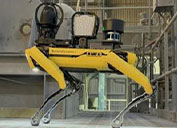
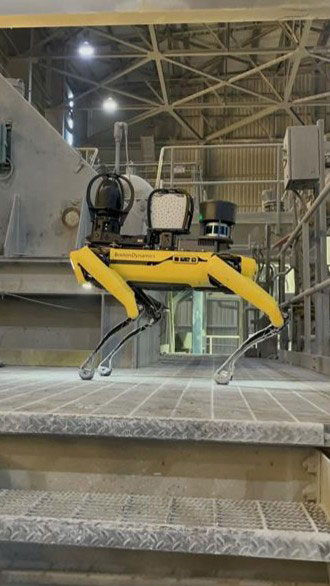 January 27, 2026 - Spot, the new four-legged robot roaming the production areas of Freeport’s Bagdad, Arizona, site, has most of the qualities of a top-notch working dog: hard-working, agile, reliable and efficient.
Cuddly and affectionate? Not quite, but it doesn’t shed and requires no cleanup.
Recently added to the site, the fully autonomous machine follows a pre-determined route using sophisticated sensors to verify equipment condition and detect early warning signs of potential issues.
If Spot detects a problem, a human technician follows up to make any further diagnosis or repair.
The work is tedious for humans, especially walking the miles of conveyor belts in the summer when temperatures run extremely high, said Manuel Cadenas, Manager, Growth-Bagdad.
That’s where Spot comes in. Unaffected by heat or long distances, the robot dog can patrol areas that are physically demanding for people.
Equipped with thermal and acoustic sensors, Spot can determine whether any piece of equipment is operating outside of specifications or making unusual noises that may be an early sign of failure. If a potential problem is found, Spot also is equipped with a camera that can rotate 360 degrees and take photographs of areas of concern. All the data collected is later downloaded and used to help build maintenance and repair plans.
If its batteries run low, Spot can even plug itself into a charging station in its work area.
Advancing innovation at Bagdad
“At Bagdad, we are always looking for practical ways to use technology to improve our daily work,” Cadenas said. “Spot gives us an opportunity to explore how emerging technologies can support our operations.”
The project reflects how teams are embracing the Reinvent Mining mindset by applying technology in practical, meaningful ways, Cadenas added.
While Spot resembles a mechanical dog, the design is purely practical. Each of its four legs is equipped with multiple sensors and motors, enabling it to navigate rough terrain and climb stairs in an industrial setting, according to its manufacturer.
The robot also uses a variety of sensors to detect obstacles, moving vehicles and people.
Spot – named by its manufacturer – arrived at Bagdad in November. Since then, efforts have focused on creating virtual maps of its work area to program inspection routes and capture temperature and acoustic data, said Juan Corona, Innovation Engineer II-Bagdad.
Spot has performed well so far, though it can struggle in certain areas, such as steep, narrow staircases where maintaining balance is more difficult, Corona said. The data it collects is not yet being used to develop maintenance plans but will be integrated once it proves reliable.
The initial goal is to have Spot spend a 12-hour day shift autonomously monitoring equipment without human interaction. Once Spot’s reliability and effectiveness are proven, its day will be expanded to include the night shift. Other potential uses, such as conducting inspections in hard-to-reach or dangerous areas, might be explored in the future.
Photo: Bagdad is testing a four-legged robot to conduct equipment inspections and identify signs of potential failure.




© 2026 Freeport-McMoRan
SOCIAL
RECOGNITION